Key Takeaways
- A vacuum compression backpack contains a sealed inner chamber with an air-release valve: pack soft garments, seal, press out the air, and clothing volume drops substantially.
- The "65L capacity" figure describes compression-assisted packing equivalence for soft goods — not the bag's physical volume, which expands from 35L to 45L.
- Compression works best on air-holding garments: down jackets, knitwear, fleece. It does not shrink shoes, books or electronics.
- For retailers, compression is a demonstrable feature — it sells on video and survives the returns test, unlike gimmick features.
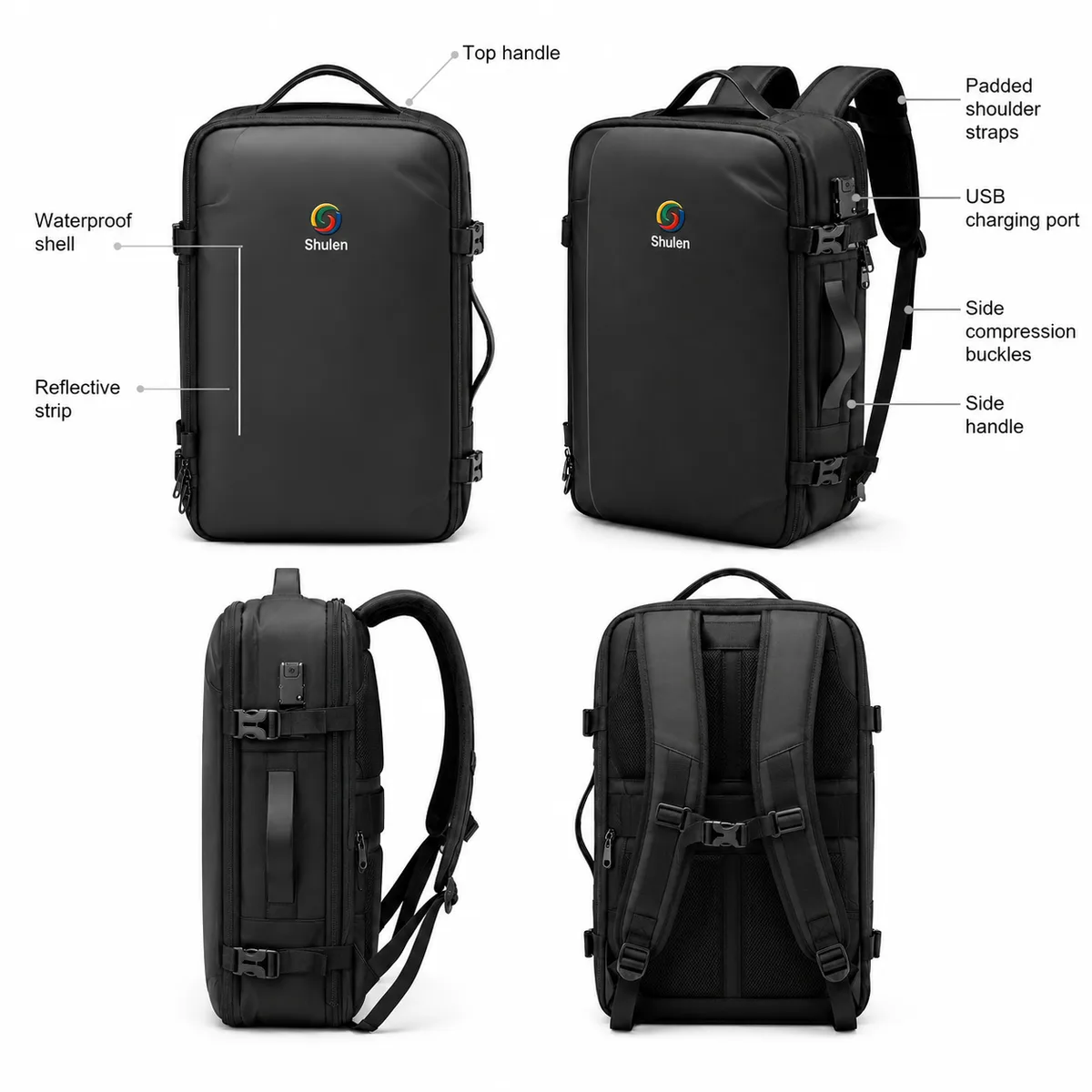
Every year a few travel-gear features cross the line from gimmick to genuinely useful. Vacuum compression is one of them — and because we build the system into our own flagship travel backpack, we can explain exactly what happens inside the bag, and what the marketing numbers really mean.
The Mechanics: Chamber, Seal, Valve
A vacuum compression backpack is really two bags in one:
- The compression chamber — a sealed internal compartment, typically taking the main packing zone, with an airtight closure.
- The air-release valve — a one-way valve on the chamber. Once the chamber is closed, pressing on the bag forces air out through the valve; the valve prevents it flowing back.
Soft garments are mostly trapped air. A down jacket can lose more than half its packed volume when that air is squeezed out; sweaters and fleece behave similarly. Compress the clothing layer, and space appears for everything else. No external pump is required for everyday use — body weight on the bag does the job.
Decoding the Numbers: 35L, 45L, 65L
Compression backpack listings quote three figures, and buyers should understand each:
| Figure | What It Means |
|---|---|
| 35L base | Physical volume with the expansion zipper closed — the slim, commuter-friendly profile at 510 × 320 × 190 mm. |
| 45L expanded | Physical volume with the depth expansion opened (+45 mm) — the week-long-trip configuration. |
| Up to 65L | A packing-equivalence claim: the amount of uncompressed soft clothing that fits once compressed. It is not the bag's physical volume. |
Honest marketing states this distinction plainly — and we recommend our B2B partners do the same in their listings. It builds trust and cuts return rates.
What Compression Can and Can't Do
Compresses well: down and synthetic-fill jackets, sweaters, hoodies, T-shirts in bulk, towels, bedding.
Doesn't compress: shoes, hard cases, electronics, tailored jackets you want crease-free. A good compression bag layout — like the clamshell design with separate zones we use — keeps compressibles in the chamber and everything else in structured pockets.
Why the Feature Sells (A Note for Retail Buyers)
Three commercial observations from partners ranging our compression backpack:
- It demos in seconds. A 15-second video of a puffer jacket disappearing into a slim backpack outperforms any spec sheet in social ads.
- It survives ownership. Unlike gadget features that go unused after week one, travelers use compression every trip — driving reviews and referrals.
- It justifies premium pricing. Function that users feel supports a price position above commodity backpacks — our whole philosophy of differentiation over price wars.
Choosing a Compression Backpack: Buyer's Checklist
- One-way valve quality — the failure point on cheap versions; ours passes repeated-cycle QC testing.
- Chamber seal design — look for wide, glove-friendly closures.
- Carry-on dimensions in the compressed state, verified against airline limits.
- The rest of the bag — compression is no excuse for weak straps, poor back panels or missing security hardware.
Want to test the system yourself? Request a sample — we ship within 3–7 days, and samples are credited against first orders.